

Many CEOs and business owners feel stuck between demand they want to capture and a plant they are not sure can deliver it. Traditional Enterprise Resource Planning (ERP) reports and spreadsheets provide fragments of information, but not a unified, real-time view of manufacturing operations.
KPIs pulled from multiple systems, each on a different refresh cycle.
Production meetings focused on reconciling numbers, not solving problems.
A persistent fear that adding more orders will tip the plant into chaos.
This is a visibility problem, and it sits at the heart of manufacturing excellence and scalability. Without a reliable, time‑phased picture of capacity, materials, and constraints, every growth decision carries unnecessary risk.
“If leaders only see fragments of what’s happening on the floor, every growth decision becomes a gamble. Modern APS for discrete manufacturing must provide a live picture of operations, not a rearview mirror.”
Edward Szukalo,
General Manager, INDUSTRIOS Software, Inc.
Generic planning tools typically rely on high‑level assumptions: rough capacity profiles, static lead times, and historic averages. They produce “generic approximations” of reality that might look reasonable on paper but often fail on the shop floor.
Advanced Planning & Scheduling for discrete manufacturing replaces these approximations with a model that reflects how your plant actually runs.
An APS-driven manufacturing environment can:
Mirror deep Bill of Materials (BOM) structures, alternate resources, and realistic changeover rules
Synchronize capacity, materials, and constraints in one planning engine.
Track how those factors evolve over time, not just at a single snapshot.
This shift is foundational for manufacturing excellence and scalability because it ensures every plan aligns with real‑world constraints, not idealized assumptions.
Visibility is not just about more charts; it is about integrated manufacturing intelligence that supports data‑driven decision making. Instead of one‑off reports, manufacturers need analytics that are:
Integrated: pulling from ERP, shop‑floor data collection, and APS in a single model.
Real‑time: updated as production events and schedule changes occur.
Actionable: tied directly to planning and scheduling decisions, not just historical review.
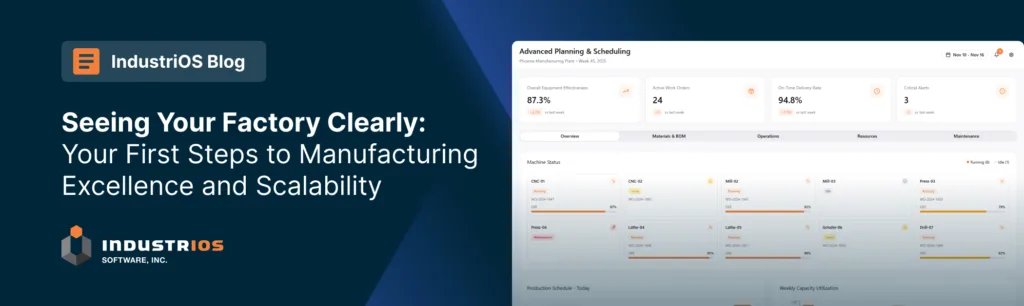
INDUSTRIOS APS (powered by LOGIS) delivers this integrated manufacturing intelligence through the LOGIS KPI Dashboard embedded in the INDUSTRIOS environment. Planners and executives share the same real-time, time‑phased view of performance, so they can manage increased volume without chaos, spot trends early, and reduce micromanagement while still monitoring the health of the plant at a glance.
With this level of integrated manufacturing intelligence, executives can move beyond instinct and manage by facts, aligning investment, product mix, and staffing decisions with what the factory can realistically support.
A key benefit of APS‑driven visibility is real‑time production synchronization across resources. When every schedule change is grounded in current capacity and material status, the plant can:
Improve on‑time delivery performance because promises reflect real constraints.
Reduce lead times and Work In Progress (WIP) inventory by keeping work flowing steadily through bottlenecks.
Coordinate upstream and downstream operations so departments move in lockstep rather than working at cross‑purposes.
These are core elements of both customer satisfaction and manufacturing excellence, and they become measurable once APS feeds accurate data into dashboards and analytics.
In low‑visibility environments, managers often default to micromanagement: constant walkarounds, status calls, and firefighting. With APS‑driven KPIs and integrated analytics, leaders can switch to management by exception.
Exceptions such as overloads, late orders, or rising queue times stand out immediately.
Stable areas receive minimal intervention, freeing time for improvement initiatives.
Cross‑functional discussions start from a shared data set, reducing conflict between departments.
This is where scaling stops being a source of anxiety and becomes a controlled, repeatable process.
“Visibility is the foundation of manufacturing excellence and scalability. Once you trust what you’re seeing, you can start to optimize flow, not just react to problems.”
Edward Szukalo,
General Manager, INDUSTRIOS Software, Inc.
Manufacturing excellence and scalability depend on more than new machines; they require clear, real-time visibility into how your factory actually runs. By combining Advanced Planning & Scheduling for discrete manufacturing with integrated manufacturing intelligence, leaders can scale with confidence, using data-driven decision making instead of guesswork. Request a Demo to see how these principles are applied in practice.
If you are ready to move from better visibility to better decisions, the next step is exploring how simultaneous capacity and material planning breaks down silos between materials and production. Stay tuned for Part 2 in this series to see how a Planning Desk and real-time production synchronization replace the spreadsheet shuffle with true data-driven decision making.

Download 1 of 11 Continuous
Improvement Templates