Menu

Fixed Asset Management: What It Is and How You Can Manage It Effectively

Fixed Asset Management

8–12 minutes

Manual spreadsheets, scattered records, and last-minute audit scrambles leave assets unverified and financials exposed. Fixed asset management is one of the most important processes in any discrete manufacturing company. It’s responsible for maintaining and accounting for tangible, intangible, and financial assets within a company.

In this article, we want to explain to you why the stability and profitability of your company are linked to the quality and condition of your fixed assets, and how you can improve your fixed asset management system.

TL;DR: Quick Summary

Fixed assets—machinery, buildings, vehicles, and equipment—are the backbone of any manufacturing operation, and managing them well directly impacts profitability. The global fixed asset management market hit roughly $264.68 billion in 2023 and is projected to reach $1,379 billion by 2030 (28.3% CAGR), driven by cloud adoption, IoT tracking, and tightening compliance requirements. To manage fixed assets more effectively, manufacturers should maintain an accurate asset register, foster cross-departmental coordination, enforce clear handling procedures, and leverage dedicated asset management software for real-time tracking, depreciation reporting, and maintenance scheduling.


Getting Your Terminology Right

What are Fixed Assets?

When you’re walking through your factory, you’re surrounded by fixed assets. These can be buildings, heavy machinery, vehicles, furniture, and even the land your factory stands on. Fixed assets, also known as capital assets, are physical assets that a manufacturer owns and actively uses to generate income and support its operations.

“Fixed assets should not be mistaken for current assets, like inventory or cash. Fixed assets are not intended for sale or any form of short-term consumption. These assets are your company’s infrastructure and are typically held for more than one accounting year.” – Edward Szukalo, General Manager of INDUSTRIOS Software

These assets require significant investment and are subject to depreciation over time. Because they gradually lose value through wear and tear or obsolescence, properly managing fixed assets is important for ensuring their optimal use.

What is Fixed Asset Management?

Fixed asset management is the process of managing the aforementioned physical assets (e.g., vehicles, heavy equipment, etc.). Dedicated software solutions are widely used for this purpose, as they monitor each stage of an asset’s lifecycle and strategically track its performance. The right monitoring software can provide you with detailed information such as purchase date, cost, depreciation rate, location, and condition.

“Tracking can be achieved through a variety of methods, including barcodes and RFID tags. With real-time asset tracking, organizations can guard against loss, theft, and misplacement, making sure every asset is exactly where it needs to be when it’s needed.” – Edward Szukalo

Beyond tracking, fixed asset management is also responsible for evaluating how well each asset performs and keeping maintenance costs under control. It helps pinpoint underperforming or outdated equipment that may be ready for disposal, while also planning and scheduling routine maintenance to extend each asset’s useful life and keep performance at its peak.

These solutions consolidate all asset information into a single platform that supports multiple workflows, from procuring new fixed assets and coordinating service activities to generating reports for deeper data analysis.

Fixed Asset Management Market Trends

The global fixed asset management market was valued at approximately USD 264.68 billion in 2023 and is expected to expand at a compound annual growth rate (CAGR) of 28.3% between 2024 and 2030. This trajectory reflects a worldwide surge in the adoption of cloud-based solutions for fixed asset oversight. Several key drivers are fueling this growth: the accelerating shift toward automation and digitization across industries is heightening demand for more effective asset tracking and management tools. 

Fixed Asset Management Market Growth

Global Fixed Asset Management Market

Projected Growth 2023 – 2030

$264.7B
2023 Market Size
28.3%
CAGR 2024–2030
$1,379B
Est. 2030 Value

At the same time, increasingly stringent regulatory compliance standards are pushing organizations to invest in solutions that deliver accurate asset reporting. Government requirements around asset tracking, depreciation, and reporting continue to generate strong demand for advanced fixed asset management systems.

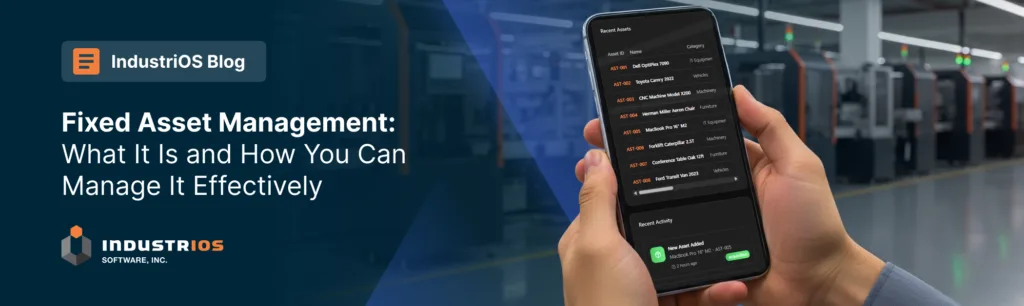
Industrios banner image on fixed asset management

Tips on How to Manage Fixed Assets More Efficiently

Now that we’ve covered all of the terms, let’s focus on how manufacturers can improve their fixed asset management in four simple ways.  

1. Maintain an Accurate Asset List

The foundation of effective asset management is creating a comprehensive and accurate record of all the tangible, intangible, and financial long-term assets your company owns to generate revenue. Maintaining this list provides three major benefits:

  • Better Tracking and Maintenance: It allows you to monitor the condition and performance of your equipment. By pairing this visibility with a preventive maintenance plan, you can extend the useful life of your assets, prevent costly downtime, and improve overall operational efficiency.
  • Accurate Financial Reporting: Fixed assets make up a massive portion of a company’s balance sheet. Having precise records ensures you are reporting accurate valuations, which is critical for investors and other stakeholders.
  • Optimized Utilization: Regularly reviewing your asset roster helps you identify equipment that is underperforming, underutilized, or completely idle. This insight allows leadership to make better decisions about reallocating resources or disposing of obsolete items.

2. Foster Inter-Departmental Coordination

Even though fixed asset management is typically handled by a single dedicated department, it shouldn’t happen in a silo. Establishing regular check-ins between different departments is vital. These meetings keep everyone informed about broader company operations and ensure that all teams are aligned toward a shared goal of effective asset management. Furthermore, this cross-departmental visibility leads to much better decision-making, as team leaders understand how asset usage in their area impacts the rest of the organization.

3. Implement Strict Procedures and Clear Guidelines

Having well-defined procedures for managing fixed assets is highly beneficial for any organization. Strict guidelines ensure that every asset is properly accounted for and utilized to its fullest potential. More importantly, clear rules help prevent costly discrepancies and tracking errors. When employees know exactly how to handle, report, and maintain assets, the company naturally improves its efficiency, reduces unnecessary costs, and mitigates operational risks.

Clear Guidelines

Strict Procedures

Track
Account
Maintain
Report

4. Leverage Fixed Asset Management Software

Relying on manual tracking can leave room for error, which is why adopting dedicated asset management software is a game-changer. These systems automate and streamline the entire process, making it incredibly easy to track your fixed assets. Software provides real-time data regarding an asset's location, current condition, and financial value, which helps organizations make informed decisions about allocation and disposal. Additionally, these platforms reduce the risk of theft or loss and make it much easier to comply with strict financial reporting and tax regulations.

Manage Your Fixed Assets Better

For finance teams ready to explore integrated asset management solutions, the INDUSTRIOS Fixed Asset Management brochure provides detailed insights into proven approaches that have helped manufacturing companies eliminate reconciliation stress while improving reporting accuracy and compliance.

Get Access to the INDUSTRIOS Fixed Asset Management Brochure

Gain clarity on every asset—fast. Spreadsheets and scattered records make audits stressful and asset losses costly. The INDUSTRIOS Fixed Asset Management Brochure shows you a simpler, cloud-powered way to track, value, and report on everything you own.
[Download Fixed Asset Management Brochure]

Up Next
  • The Invisible Factory: Whitepaper
    The Invisible Factory: Whitepaper
  • PlantGauge Data Sheet
    PlantGauge Data Sheet
  • Software Data Sheet
    Software Data Sheet
  • Distribution Suite Data Sheet
    Distribution Suite Data Sheet
  • Project Manufacturing Data Sheet
    Project Manufacturing Data Sheet
  • PlantCare Overview
    PlantCare Overview
  • PlantUp! Datasheet
    PlantUp! Datasheet
  • SteppingStones Overview
    SteppingStones Overview
  • Inventory Control and Costing
    Inventory Control and Costing
  • Manufacturing CRM
    Manufacturing CRM
  • Production and Scheduling
    Production and Scheduling
  • Procurement and Materials
    Procurement and Materials
  • Sales Management
    Sales Management
  • Logis Partnership
    Logis Partnership
  • Make-to-Order Make-to-Stock
    Altron Automation Achieves Precision and Cost Savings
    Altron Automation halved purchasing costs and reached 99.5% inventory accuracy by upgrading to INDUSTRIOS ERP, enabling real-time inventory management, automated job tracking, and data-driven process improvements for scalable, efficient growth.
    Altron Automation, a leading Michigan-based systems integrator for the automotive and heavy truck industries, transformed its operations by upgrading its INDUSTRIOS custom manufacturing ERP.
    Read Success Story
    Make-to-Order Make-to-Stock
    AMPCO Sustains Growth and Efficiency with INDUSTRIOS ERP
    Managing Growth with INDUSTRIOS ERP: How AMPCO Maintained Efficiency and Customer Service Amid Surging Sales
    American Metal Products Company (AMPCO), a Portland-based tube bending and metal forming specialist, doubled sales over three years while maintaining fast lead times and competitive pricing
    Read Success Story
    Make-to-Order
    Cam Tran Modernizes Operations, Achieves 80% Payroll Time Savings
    Cam Tran upgraded to INDUSTRIOS ERP, cutting payroll processing time by 80% and automating data tracking. Real-time production monitoring and lean-ready workflows now drive efficiency, collaboration, and scalable growth.
    Cam Tran Co. Ltd., a leading North American transformer manufacturer, modernized its payroll and production processes by upgrading to the latest INDUSTRIOS ERP.
    Download Success Story
    Make-to-Order Make-to-Stock
    Real-Time Inventory and Scheduling Power Leone Fence’s Growth
    Leone Fence increased customer satisfaction by 40% through real-time inventory visibility, automated subcontractor scheduling, and seamless ERP integration, enabling proactive purchasing, accurate order tracking, and scalable growth.
    Leone Fence, the largest commercial and industrial fence installer in the Greater Toronto Area, transformed its operations by integrating INDUSTRIOS with Sage 300 ERP.
    Download Success Story
    Project Manufacturing
    Plas-Tech Automates Job Tracking and Inventory for Greater Efficiency
    Plas-Tech Inc. improved inventory accuracy and automated job tracking with INDUSTRIOS ERP, enabling real-time material visibility, data-driven cost analysis, and streamlined reporting to support efficient, scalable growth.
    Plas-Tech Inc., a custom plastic fabrication company in Concord, Ontario, transformed its operations by implementing INDUSTRIOS ERP.
    Read Success Story
    Make-to-Order
    Pratt & Larson Unifies Inventory and Shipping with INDUSTRIOS
    Pratt & Larson unified inventory and shipping with INDUSTRIOS, enabling real-time tracking, seamless workflows, and faster order fulfillment that improved accuracy, financial clarity, and client satisfaction across artisan tile production.
    Pratt & Larson Ceramics, a premier artisan tile manufacturer, transformed its operations with INDUSTRIOS custom manufacturing ERP.
    Download Success Story
    Make-to-Stock
    SmithCo Manufacturing Automates Labor & Payroll with INDUSTRIOS ERP
    SmithCo Manufacturing automated labor tracking and payroll with INDUSTRIOS ERP, gaining real-time job cost visibility, and streamlining production management. Seamless integration boosted efficiency, accuracy, and positioned SmithCo for continued growth.
    SmithCo Manufacturing, a leading producer of side dump trailers in Le Mars, Iowa, transformed its operations by implementing INDUSTRIOS ERP. Key achievements include:
    Read Success Story
    Make-to-Order
    UMC Optimizes Shipping and Inventory with INDUSTRIOS
    Universal Motion Components (UMC) streamlined shipping and improved inventory planning with INDUSTRIOS ERP. Enhanced data access and automated purchasing enable faster, more accurate deliveries, and support operational growth.
    Universal Motion Components (UMC), based in Costa Mesa, California, is a leading supplier of drive line components for the agriculture and construction industries.
    Download Success Story
    Make-to-Stock
    Universal Stenciling Grows Efficiently with INDUSTRIOS ERP
    Universal Stenciling streamlined inventory and accelerated order fulfillment using INDUSTRIOS ERP. They now fulfill 90% of orders within 24 hours and manage over 3,000 raw materials with accuracy.
    Universal Stenciling & Marking Systems, a family-owned innovator in marking, stenciling, and coding equipment since 1904, leveraged INDUSTRIOS ERP to:
    Download Success Story
    Harnessing the power of employee engagement through real time metrics

    Explore the concept of the employee engagement and how technology can impact adoption of practices that foster employee engagement. Jacques Decarie, Vice-President of Sales and Marketing with INDUSTRIOS and Jenice Rideout, President of HR Navigation Inc. provide an overview of how to apply practices to drive your team to exceptional performance.

    What's New - Handling Order to Cash processes with INDUSTRIOS

    This webinar provides an overview of how INDUSTRIOS can help you handle business processes from the time an order is received to the point where it is converted to cash. Areas covered include: Navigation, Customers, Sales Orders, Shipping and Reporting.

    What's New - Inventory Control and Costing

    Eva DeGasperis, Principal at Industrios, and Jacques Decarie, Vice President of Sales and Marketing, take a deep dive into inventory control and costing. Hear Eva talk quantity constraints, unit tracking, cost elements, valuation methods, and much, much more.

    Webinar: How the Invisible Factory will help get you back on course

    As owner of a manufacturing company, you shouldn’t be on the shop floor. You’re needed at the helm, steering the business to where it needs to go. From software to human resources, here’s what IndustriOS’ Invisible Factory can do for you.

    Webinar: INDUSTRIOS on the Cloud

    Jacques Decarie, INDUSTRIOS, and Joe Cudzik, Expedient, explain your cloud options and address your questions about ERP. You’ll learn about accessibility 24/7 on any device, enhanced security, disaster recovery and much more.

    ERP Business Benefits for Manufacturers
    Practical Business Intelligence for Manufacturers