

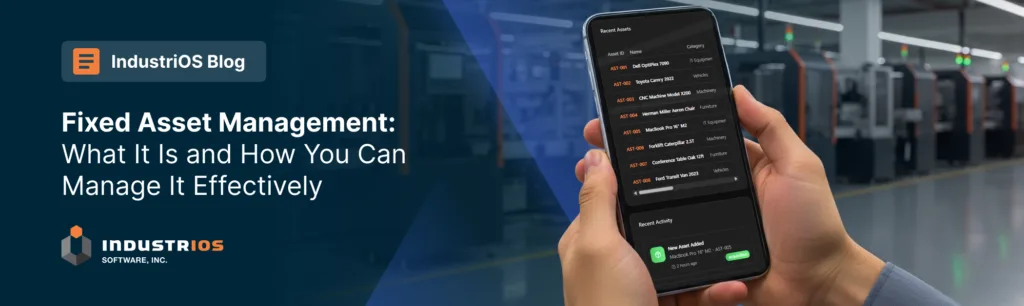
Manual spreadsheets, scattered records, and last-minute audit scrambles leave assets unverified and financials exposed. Fixed asset management is one of the most important processes in any discrete manufacturing company. It’s responsible for maintaining and accounting for tangible, intangible, and financial assets within a company.
In this article, we want to explain to you why the stability and profitability of your company are linked to the quality and condition of your fixed assets, and how you can improve your fixed asset management system.
Fixed assets—machinery, buildings, vehicles, and equipment—are the backbone of any manufacturing operation, and managing them well directly impacts profitability. The global fixed asset management market hit roughly $264.68 billion in 2023 and is projected to reach $1,379 billion by 2030 (28.3% CAGR), driven by cloud adoption, IoT tracking, and tightening compliance requirements. To manage fixed assets more effectively, manufacturers should maintain an accurate asset register, foster cross-departmental coordination, enforce clear handling procedures, and leverage dedicated asset management software for real-time tracking, depreciation reporting, and maintenance scheduling.
When you’re walking through your factory, you’re surrounded by fixed assets. These can be buildings, heavy machinery, vehicles, furniture, and even the land your factory stands on. Fixed assets, also known as capital assets, are physical assets that a manufacturer owns and actively uses to generate income and support its operations.
“Fixed assets should not be mistaken for current assets, like inventory or cash. Fixed assets are not intended for sale or any form of short-term consumption. These assets are your company’s infrastructure and are typically held for more than one accounting year.” – Edward Szukalo, General Manager of INDUSTRIOS Software
These assets require significant investment and are subject to depreciation over time. Because they gradually lose value through wear and tear or obsolescence, properly managing fixed assets is important for ensuring their optimal use.
Fixed asset management is the process of managing the aforementioned physical assets (e.g., vehicles, heavy equipment, etc.). Dedicated software solutions are widely used for this purpose, as they monitor each stage of an asset’s lifecycle and strategically track its performance. The right monitoring software can provide you with detailed information such as purchase date, cost, depreciation rate, location, and condition.
“Tracking can be achieved through a variety of methods, including barcodes and RFID tags. With real-time asset tracking, organizations can guard against loss, theft, and misplacement, making sure every asset is exactly where it needs to be when it’s needed.” – Edward Szukalo
Beyond tracking, fixed asset management is also responsible for evaluating how well each asset performs and keeping maintenance costs under control. It helps pinpoint underperforming or outdated equipment that may be ready for disposal, while also planning and scheduling routine maintenance to extend each asset’s useful life and keep performance at its peak.
These solutions consolidate all asset information into a single platform that supports multiple workflows, from procuring new fixed assets and coordinating service activities to generating reports for deeper data analysis.
The global fixed asset management market was valued at approximately USD 264.68 billion in 2023 and is expected to expand at a compound annual growth rate (CAGR) of 28.3% between 2024 and 2030. This trajectory reflects a worldwide surge in the adoption of cloud-based solutions for fixed asset oversight. Several key drivers are fueling this growth: the accelerating shift toward automation and digitization across industries is heightening demand for more effective asset tracking and management tools.
Projected Growth 2023 – 2030
At the same time, increasingly stringent regulatory compliance standards are pushing organizations to invest in solutions that deliver accurate asset reporting. Government requirements around asset tracking, depreciation, and reporting continue to generate strong demand for advanced fixed asset management systems.
Now that we’ve covered all of the terms, let’s focus on how manufacturers can improve their fixed asset management in four simple ways.
The foundation of effective asset management is creating a comprehensive and accurate record of all the tangible, intangible, and financial long-term assets your company owns to generate revenue. Maintaining this list provides three major benefits:
Even though fixed asset management is typically handled by a single dedicated department, it shouldn’t happen in a silo. Establishing regular check-ins between different departments is vital. These meetings keep everyone informed about broader company operations and ensure that all teams are aligned toward a shared goal of effective asset management. Furthermore, this cross-departmental visibility leads to much better decision-making, as team leaders understand how asset usage in their area impacts the rest of the organization.
Having well-defined procedures for managing fixed assets is highly beneficial for any organization. Strict guidelines ensure that every asset is properly accounted for and utilized to its fullest potential. More importantly, clear rules help prevent costly discrepancies and tracking errors. When employees know exactly how to handle, report, and maintain assets, the company naturally improves its efficiency, reduces unnecessary costs, and mitigates operational risks.
Clear Guidelines
Strict Procedures
Relying on manual tracking can leave room for error, which is why adopting dedicated asset management software is a game-changer. These systems automate and streamline the entire process, making it incredibly easy to track your fixed assets. Software provides real-time data regarding an asset's location, current condition, and financial value, which helps organizations make informed decisions about allocation and disposal. Additionally, these platforms reduce the risk of theft or loss and make it much easier to comply with strict financial reporting and tax regulations.
For finance teams ready to explore integrated asset management solutions, the INDUSTRIOS Fixed Asset Management brochure provides detailed insights into proven approaches that have helped manufacturing companies eliminate reconciliation stress while improving reporting accuracy and compliance.
Get Access to the INDUSTRIOS Fixed Asset Management Brochure
Gain clarity on every asset—fast. Spreadsheets and scattered records make audits stressful and asset losses costly. The INDUSTRIOS Fixed Asset Management Brochure shows you a simpler, cloud-powered way to track, value, and report on everything you own.
Download 1 of 11 Continuous
Improvement Templates