A manufacturing environment is the operating model that decides when production starts and what triggers it. Make-to-stock builds to a forecast before orders arrive. Make-to-order builds after an order is placed. The other environments sit between those two, or combine them. Your environment shapes how you plan, hold inventory, cost jobs and promise delivery dates.
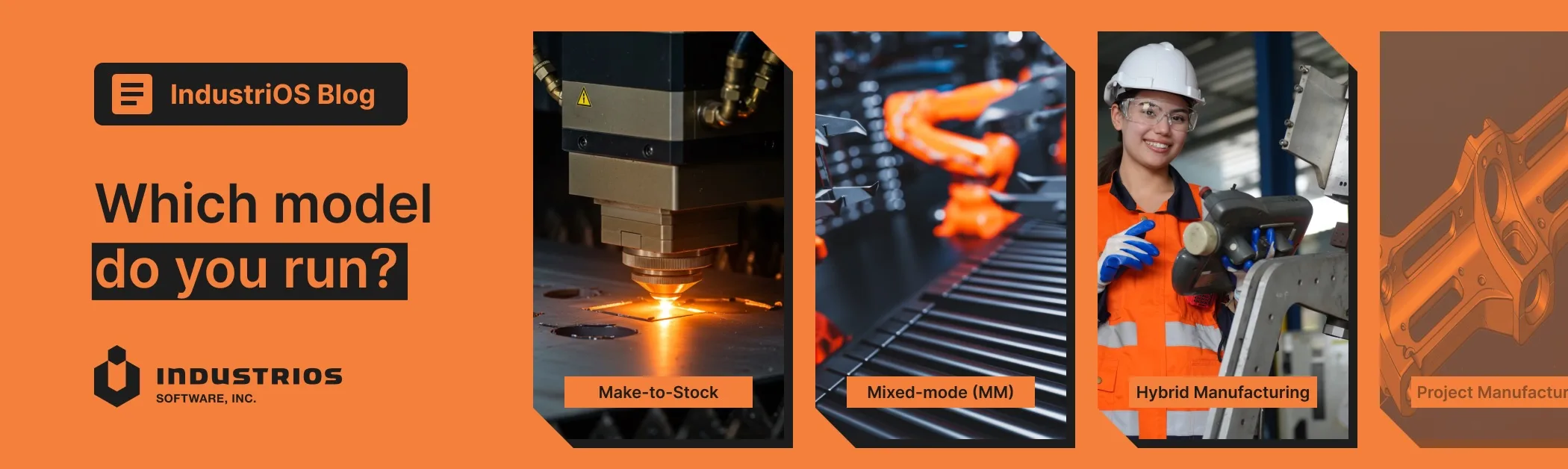
Environment Make-to-order (MTO) | What it means Products are designed and built after the order, and “unique” orders often turn out to be repeats | Typical challenge Accurate costs and inventory across shop floor, procurement and sales | What ERP needs to do Integrate shop floor tracking, procurement, sales order fulfilment and inventory control |
| Mixed-mode (MM) | A blend of several manufacturing styles in one operation | Inventory for raw materials, subassemblies and finished goods at once | Flexible inventory rules; segment jobs for volume purchasing; start jobs on schedule or on the fly |
| Hybrid | A process line (forming, extruding, coating or laminating) feeds custom fabrication | Two plans that don’t align across a shared line | Plan both stages in one plan; two-stage costing; end-to-end traceability |
| Project | Pre- and post-production phases (design, engineering, installation, commissioning) around production | Tracking every phase, not just production | Multiple budgets and milestones; shipping BOMs; bin reservation for long-lead components |
| Assemble-to-order (ATO) | Components are stocked and assembled when the order arrives | The cost of holding inventory for short lead times | Minimum stocking levels; a master production schedule for stocked components |
| Minimum stocking levels; a master production schedule for stocked components | The customer chooses options when ordering | Predetermined finished goods inventory is hard to maintain | Fast, accurate costing, BOMs and routings for each configuration |
| Make-to-stock (MTS) | Production follows a master schedule driven by a sales forecast | Setting stocking constraints correctly | Inventory analysis tools and multiple forecasts in planning |
If you’ve designed and built what you thought was a one-off order, then received another order for the same or a very similar product, that’s make-to-order. Costing is the critical discipline; see Job Costing in Make-to-Order Manufacturing.
As demand for discrete manufacturing has grown, so has the need for custom approaches that blend several manufacturing styles. A mixed-mode plant might make some items to stock and others to order, on the same floor.
A hybrid plant has a process line that feeds custom fabrication. Because the process plan and the discrete plan are usually built separately, they rarely line up. See Hybrid Manufacturing: Shared Capacity Planning, Two-Stage Costing and End-to-End Traceability.
Project manufacturing wraps production in other phases, such as design, engineering, prototyping, installation and commissioning. Your ERP needs to plan and track all of them, not just the build. Engineer to Order ERP covers complex project work in industrial equipment.
If juggling inventory for short lead times frustrates you, you’re facing the classic assemble-to-order dilemma. The aim is to stock the right subassemblies and raw materials so you can assemble quickly once the order lands.
Customers define the product’s components or configuration when they order, which makes predetermined finished goods inventory hard to hold. Speed and accuracy in costing each configuration matter most. See ERP for Configure-to-Order Manufacturing.
Items are produced according to a master production schedule driven by a sales forecast. Stocking constraints and forecast quality decide whether you carry too much or run short.
Ask three questions:
If you answer “both” or “it depends” to any of them, you probably run more than one environment. That’s normal. It also matters when choosing an ERP that won’t need heavy customization; see Mid Market ERP Implementation.
Find your manufacturing model → https://industrios.com/approach/manufacturing-environments/
What’s the difference between make-to-order and engineer-to-order?
Make-to-order builds a defined product after the order arrives.
Engineer-to-order adds design and engineering for each order, so it is usually run as project manufacturing.
Is mixed-mode the same as hybrid manufacturing?
No. Mixed-mode blends discrete styles, such as MTS and MTO. Hybrid means a process stage feeding a discrete stage.
Can one ERP support several manufacturing environments?
Yes, if it lets you set inventory, planning and costing rules by item or job rather than for the whole plant.
Which environment carries the most inventory risk?
Make-to-stock, because it commits to production before orders exist. Assemble-to-order shifts that risk to components and subassemblies.
Related reading: Hybrid Manufacturing: Shared Capacity Planning · Two-Stage Costing · End-to-End Traceability.

Download 1 of 11 Continuous
Improvement Templates