End-to-End Traceability for Hybrid Manufacturers: From Raw Material Lot to Finished Item
End-to-End Traceability Key Takeaways
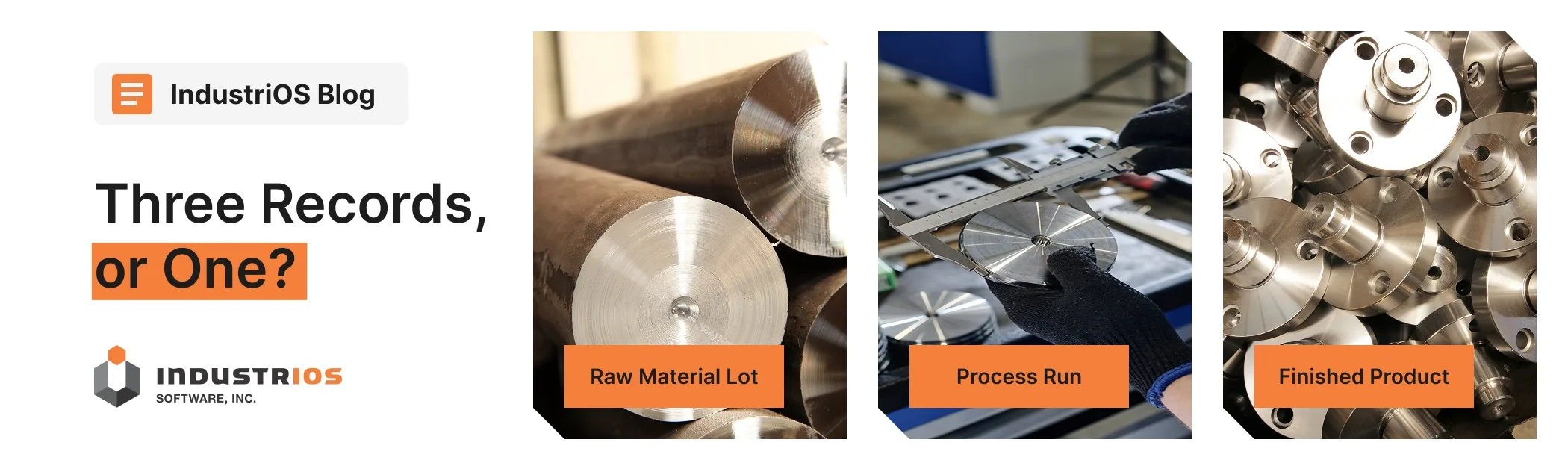
In hybrid manufacturing, a finished item’s history runs through three steps: the raw material lot, the process run and the production work.
When each step is recorded in a separate place, traceability is fragmented, and audit prep takes weeks of manual effort.
End-to-end traceability links all three in one system with one audit trail.
Audit prep becomes a report query, and quality incidents resolve faster because affected lots, runs and batches can be identified at once.
What is end-to-end traceability?
End-to-end traceability is the ability to follow any finished item back through every stage that made it, and forward to everything a given input went into. For a hybrid manufacturer, that means linking three records: the raw material lot, the process run that turned it into an intermediate material, and the discrete job that turned that material into the finished item.
Why is traceability harder in hybrid manufacturing?
Because the trail crosses a stage boundary. In a single-stage shop, a lot goes into a job. In a hybrid plant, a lot goes into a process run, the run produces material, and that material is split across several production jobs.
If receiving records, line logs and job paperwork live in different systems, or in spreadsheets, a single trace means stitching three records together by hand. That’s where the weeks of audit prep come from.
Which hybrid industries need tighter traceability?
Nonwoven filtration media: lot traceability for antimicrobial or chemical finishes.
Foam fabrication: medical-grade traceability when serving healthcare.
Composites fabrication: AS9100 traceability for aerospace work.
Flexible packaging: food-contact traceability.
What does a hybrid traceability record need to capture?
Raw material lot: supplier, lot number and receipt details.
Process run: which lots went in, when the run happened, and what it produced.
Intermediate material: the rolls, sheets or blocks from that run, each identifiable.
Discrete job: which intermediate material each production job consumed.
Finished item and shipment: which customer order and shipment the item went to.
With those links in place, a trace works in both directions. You can go from a finished item back to the raw material, or from a suspect lot forward to every shipment it touched. Clean supplier records help too; see How to Fix Supply Chain Problems with ERP.
How do you prepare for a traceability audit?
Run a test trace on a recent shipment, and time how long it takes.
List every system and spreadsheet the trace touched.
Close the gaps so each step links to the next automatically.
What is the difference between lot traceability and end-to-end traceability? Lot traceability follows a lot of material. End-to-end traceability follows it through every stage, including the process run and the production work, to the finished item and the customer.
What is backward and forward traceability? Backward traceability starts with a finished item and finds its inputs. Forward traceability starts with an input, such as a suspect lot, and finds every item and shipment it went into.
Why does traceability affect recall response? If you can identify exactly which lots, runs and batches are affected, you can act on those alone instead of on everything made around that time.
What should I look for in an ERP for traceability? One record that spans both stages, without re-keying. How to Choose Manufacturing ERP Softwarecovers the wider checklist.
This approach ensures that our project team tailors a proposal and project to meet your specific needs, mitigates risk, and gives you the confidence that you will get what you need. We believe in going beyond technology and making our software work for you. Contact IndustriOS and improve your manufacturing processes today.
To provide the best experiences, we use technologies like cookies to store and/or access device information. Consenting to these technologies will allow us to process data such as browsing behavior or unique IDs on this site. Not consenting or withdrawing consent, may adversely affect certain features and functions.
Functional
Always active
The technical storage or access is strictly necessary for the legitimate purpose of enabling the use of a specific service explicitly requested by the subscriber or user, or for the sole purpose of carrying out the transmission of a communication over an electronic communications network.
Preferences
The technical storage or access is necessary for the legitimate purpose of storing preferences that are not requested by the subscriber or user.
Statistics
The technical storage or access that is used exclusively for statistical purposes.The technical storage or access that is used exclusively for anonymous statistical purposes. Without a subpoena, voluntary compliance on the part of your Internet Service Provider, or additional records from a third party, information stored or retrieved for this purpose alone cannot usually be used to identify you.
Marketing
The technical storage or access is required to create user profiles to send advertising, or to track the user on a website or across several websites for similar marketing purposes.