


AI in manufacturing is everywhere in the conversation. But for discrete manufacturers running MTO, ETO, or CTO operations, the question isn’t whether AI matters. It’s where it actually delivers measurable results versus where it’s still more promise than payoff.
This guide covers the five areas where AI is already creating operational value on manufacturing shop floors, what separates practical AI adoption from expensive experiments, and how INDUSTRIOS is approaching AI integration for its customers.
AI delivers the highest near-term ROI in predictive maintenance, production scheduling, and quality inspection, areas where data is already being collected but underused.
Severe manufacturing injuries dropped 68% from 2023 to early 2024, driven in part by smarter risk mitigation including AI-enhanced monitoring systems.
The global predictive maintenance market is projected to reach $122.8 billion by 2032, signaling that manufacturers are investing heavily in failure prevention over reactive repair.
Not every AI application is ready for production. The practical ones share three traits: they solve a problem you already have, they work with data you already collect, and they deliver outcomes you can measure within months, not years.
Here’s where AI for discrete manufacturing is proving itself today:
 AI for Discrete Manufacturing: Intelligent Operations in Industrial Equipment Production
Read Article →
AI for Discrete Manufacturing: Intelligent Operations in Industrial Equipment Production
Read Article →
Unplanned downtime is one of the most expensive problems in manufacturing. AI in predictive maintenance analyzes sensor data, historical maintenance logs, and operational patterns to predict failures before they happen. According to Deloitte, this approach increases equipment uptime by 10-20% while reducing overall maintenance costs by 5-10%. This isn’t theoretical. It’s happening on shop floors right now.
 AI in Predictive Maintenance: How to Prevent Downtime on the Shop Floor
Read Article →
AI in Predictive Maintenance: How to Prevent Downtime on the Shop Floor
Read Article →
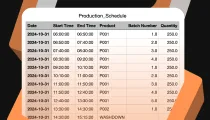
Traditional scheduling breaks down when production environments scale, products become more customizable, and supply chains grow more complex. AI in production scheduling uses machine learning to dynamically adjust plans based on real-time machine performance, labor availability, and material constraints. When a disruption hits, AI recalculates the schedule immediately rather than waiting for a planner to catch up.
 AI in Production Scheduling: Optimizing Efficiency on the Shop Floor
Read Article →
AI in Production Scheduling: Optimizing Efficiency on the Shop Floor
Read Article →
Computer vision systems identify defects on parts or assemblies faster and more accurately than human inspectors. They analyze images in real time, flagging anomalies and reducing scrap and rework costs. For high-mix manufacturers producing unique configurations, this capability prevents quality escapes without slowing throughput.
AI-powered tools provide real-time visibility into supplier performance, inventory levels, and potential disruptions. The future of supply chain management lies in systems that don’t just track information but make strategic recommendations, evaluating supplier risk, suggesting alternatives, and aligning procurement with production demand automatically.
 The Future of Supply Chain Management: AI Tools for Multi-Supplier Coordination
Read Article →
The Future of Supply Chain Management: AI Tools for Multi-Supplier Coordination
Read Article →
AI-enhanced worker safety uses computer vision, wearable sensors, and predictive analytics to identify hazards before they cause harm. Systems detect PPE non-compliance, fatigue patterns, and proximity dangers in real time. The results speak for themselves: severe manufacturing injuries fell from 8,943 incidents in 2023 to 2,856 in early 2024.
 AI-Enhanced Worker Safety: Reducing Accidents on the Shop Floor with Intelligent Systems
Read Article →
AI-Enhanced Worker Safety: Reducing Accidents on the Shop Floor with Intelligent Systems
Read Article →
Not everything labeled “AI” delivers immediate value. Manufacturers should approach these areas with healthy skepticism:
Fully autonomous decision-making.
AI works best augmenting human judgment, not replacing it. Systems that flag issues and recommend actions outperform those that try to run operations independently.
AI without clean data.
Machine learning models are only as good as the data feeding them. Manufacturers running disconnected spreadsheets and manual logs won’t see results until their data foundation is solid.
One-size-fits-all AI platforms.
Generic AI tools built for process manufacturing often miss the complexity of discrete, custom production. Solutions must fit your production type.
Manufacturers seeing real results follow a consistent pattern:
Start with one high-impact use case.
Predictive maintenance or quality inspection typically offer the fastest payback because the data already exists in most shops.
Fix your data foundation first.
AI insights depend on data quality. ERP systems that centralize production, inventory, and machine data create the foundation AI needs to work.
Integrate, don’t bolt on.
AI tools that connect seamlessly with ERP, MES, and shop floor systems deliver better outcomes than standalone solutions that create new information silos.
Measure impact from day one.
Set clear KPIs upfront: downtime reduction, defect rate improvements, schedule adherence, or maintenance cost savings. If you can’t measure it, you can’t justify expanding it.
Get stakeholder buy-in early.
Involve operations, engineering, and IT teams from the start to align AI projects with business priorities rather than chasing technology for its own sake.
INDUSTRIOS is not bolting generic AI onto its platform and calling it innovation. The 2026 Product Roadmap includes the launch of an AI Lab built around a customer-first approach: partnering directly with manufacturers to identify real use cases where AI delivers measurable results for their specific operations.
"AI is practical, and delivers value every day in manufacturing operations across industrial equipment production."
Edward Szukalo,
General Manager, INDUSTRIOS Software
The focus areas include predictive analytics, real-time monitoring, and automatic alerts that help manufacturers make smarter decisions faster. INDUSTRIOS ERP already provides the scheduling, resource management, and data infrastructure that AI requires to function effectively. The goal is to layer intelligence on top of a system that already works, not to replace what’s proven with what’s unproven.
AI in manufacturing is not a future trend. It’s a present-day capability for manufacturers willing to adopt it practically. The gap between leaders and laggards isn’t about budget or company size. It’s about whether you treat AI as a tool that solves specific, measurable problems or as a buzzword attached to vague promises of transformation.
The manufacturers who win with AI start small, measure relentlessly, and scale what works. They invest in their data foundation before chasing algorithms. And they choose partners who understand that AI only matters if it makes the shop floor run better tomorrow than it did today.

Download 1 of 11 Continuous
Improvement Templates