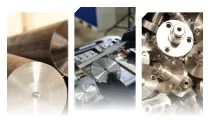
Hybrid manufacturing is a two-stage operation. A process stage makes an intermediate material, such as rolls, sheets, blocks, webs or film. A discrete stage then turns that material into production products through die-cutting, CNC routing, assembly or fabrication. In industry terms, many of these businesses are called converters.
Hybrid manufacturing sits between pure process manufacturing (continuous chemical, food and beverage, pharma) and pure discrete manufacturing (single-stage machining, assembly and job shops).
The process line is shared capacity. One forming, extrusion, coating or laminating line can feed several families of production jobs, each planned separately.
The process stage and the discrete stage usually run to their own plans, and the two plans are hard to align. When the process plan changes, nobody can see which downstream jobs are affected until a ship date slips. Many teams patch the gap with spreadsheets, which brings its own problems (see 6 Excel Production Planning Problems).
You plan both stages in one model of the plant, and treat the shared line as a real scheduling constraint rather than an afterthought. In practice that means three things:
Plan capacity and material at the same time. The shared line’s availability and the material it produces drive the production job schedule together. Simultaneous Capacity and Material Planning explains why sequential planning breaks down.
Run what-if scenarios against real constraints. Multi-scenario planning shows which orders are at risk before they’re late, not after.
This is the job of advanced planning and scheduling (APS) software working alongside ERP. Our APS guide covers it in depth.
Finite capacity planning schedules work against the capacity each resource actually has: its hours, crew, setups and downtime. Infinite capacity planning, the default in basic MRP, assumes every resource can take whatever load the plan gives it. Bottlenecks then only show up on the shop floor.
A hybrid plant’s process line is the clearest case of finite capacity. It has only so many hours, and several productionjob families compete for them. Plan it as if it were unlimited, and the schedule looks fine on paper until the line falls behind and every downstream job slips with it.
Finite capacity planning is just as important for small manufacturers as for large ones. A single shared line can set the pace for the whole plant.
Not always. If your ERP handles orders, inventory and costing well, but scheduling lives in spreadsheets, the gap is planning. Advanced planning and scheduling (APS) software adds finite capacity scheduling alongside ERP. It doesn’t replace it.
Replacement is worth considering when the problems go beyond scheduling: for example, when the system can’t cost a job across both stages, or can’t trace a finished item back to its raw material lot. In a hybrid plant, scheduling, costing and traceability all depend on linking the process stage to the discrete stage, so it’s worth checking all three before deciding.
IndustriOS APS (Powered by LOGIS) integrates directly with IndustriOS ERP. It synchronizes process production and discrete operations around material availability, shared capacity and production constraints. LOGIS accounts for machine capacity, labour and material flow, and supports fast replanning when customer orders change. Multi-scenario planning shows which orders are at risk before they’re late.
See how IndustriOS works for hybrid manufacturers → https://industrios.com/hybrid-manufacturing/
If two or more of these apply, the answer is probably yes:
Is hybrid manufacturing the same as mixed-mode manufacturing?
No. Mixed-mode blends several manufacturing styles, such as make-to-stock and make-to-order. Hybrid, as used here, means a process stage feeding a discrete stage. A plant can be both. See Manufacturing Environments Explained
What is shared capacity in manufacturing?
Shared capacity is a resource, such as a process line, oven or autoclave, that several jobs compete for. It limits how many orders can move forward at once.
Can a standard ERP handle a process line and production jobs?
Many ERP systems are built for either process or discrete manufacturing, not both. The test is whether one system can plan, cost and trace work across both stages.
What’s the difference between finite and infinite capacity planning?
Finite capacity planning schedules against what each resource can actually do. Infinite capacity planning assumes unlimited capacity, so overloads only appear on the floor.
Is APS a replacement for ERP?
No. APS works alongside ERP to schedule against real constraints. ERP still runs orders, inventory, costing and financials.
How is hybrid job costing different?
A hybrid job’s true cost spans both stages. See Two-Stage Costing
Related reading: Hybrid Manufacturing: Shared Capacity Planning · Two-Stage Costing · End-to-End Traceability

Download 1 of 11 Continuous
Improvement Templates