
Menu

Why Manufacturers Are Replacing Spreadsheets with Asset Management Software

Asset Management Software

6–9 minutes

Every month-end close tells the same story in manufacturing finance departments. Teams pull depreciation schedules from one system, cross-reference asset records in a spreadsheet, and chase down operations managers to confirm whether specific machines are still on the floor. The process is slow, error-prone, and increasingly unsustainable as asset portfolios grow.

For manufacturers carrying hundreds or thousands of fixed assets across multiple facilities, this is a structural problem, and one that asset management software is purpose-built to solve.

TL;DR: Quick Summary

Finance teams in manufacturing spend 20+ hours per month manually reconciling fixed assets, and spreadsheets are largely to blame. 88% of spreadsheets contain errors (Panko, University of Hawaii), and ghost assets, items on the books that no longer physically exist, can represent 15 to 30% of a company’s asset register (Ernst & Young). Gartner estimates poor data quality costs organizations $12.9 million per year on average. Asset management software solves this by centralizing asset data, automating depreciation, maintaining audit trails for GAAP, IFRS, and SOX compliance, and giving finance and operations teams a single source of truth.
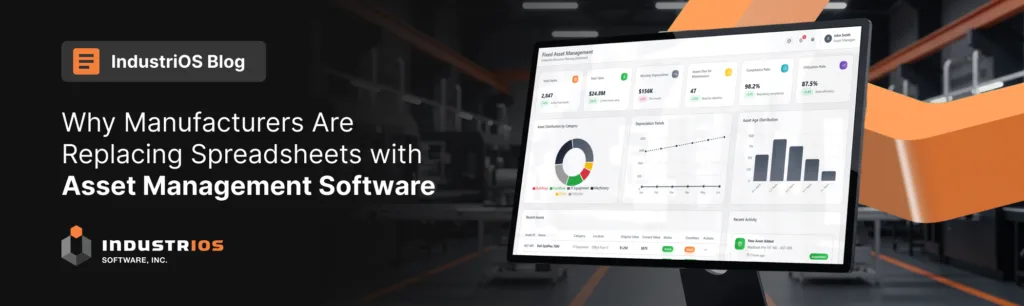

Industrios banner image on why manufacturers are replacing spreadsheets with asset management software; the image shows a display with INDUSTRIOS software

Cost of Manual Fixed Asset Reconciliation

According to a 2023 survey by the Institute of Management Accountants, finance professionals in asset-heavy industries spend an average of 20 or more hours per month on fixed asset reconciliation tasks alone. That figure accounts for verifying asset existence, recalculating depreciation, correcting entries, and preparing audit documentation.

“What we hear consistently from manufacturers is that the reconciliation process has become the bottleneck. They’re not struggling because their teams aren’t capable. They’re struggling because the tools haven’t kept up with the complexity.” – Edward Szukalo, General Manager of INDUSTRIOS Software

For mid-sized manufacturers operating across multiple plants or cost centers, the number often runs higher. Each facility introduces its own data lag. Equipment moves. Disposals happen on the shop floor before paperwork reaches finance. Depreciation method changes pile up between reporting periods. Without dedicated asset management software to centralize and automate these workflows, every close cycle becomes a manual reconstruction effort.

Spreadsheets: The Tool That Scales (Until It Doesn’t)

Much of this reconciliation burden traces back to Excel. For a company with a small number of assets, a well-maintained spreadsheet can work. But research by Dr. Raymond Panko at the University of Hawaii found that roughly 88 percent of spreadsheets contain errors, a statistic drawn from over two decades of studies reflecting the inherent fragility of manual data entry and formula management at scale.

Verified Asset
Ghost Asset
CNC Mill
Press #4
Lathe #2
Welder A
Router #1
Grinder B
Saw #3
Drill Press
Forge #1
Pump C
3 out of 10 assets on this register no longer exist on the floor
Ghost assets can represent 15–30% of a register (Ernst & Young / fixed asset audit studies)

For manufacturers, the problem intensifies because fixed asset data is never static. Depreciation methods change with regulatory updates. Assets transfer between cost centers. Disposals happen weeks before finance hears about them. A spreadsheet can’t enforce workflow, trigger status alerts, or prevent two people from editing different versions simultaneously.

The consequences are measurable. Ernst & Young has found that companies commonly carry “ghost assets,” items on the books that no longer physically exist or serve a productive purpose. Multiple fixed asset audit studies estimate ghost assets represent 15 to 30 percent of a typical asset register. Each one inflates insurance premiums, distorts depreciation expenses, and misrepresents the company’s financial position.

This is precisely the gap that asset management software is designed to close.

What Those 20+ Hours Will Cost You

When a senior accountant spends a week each month verifying asset data, that’s a week not spent on variance analysis, cost improvement, or capital planning. Gartner estimates poor data quality costs organizations an average of $12.9 million per year. Fixed assets, often the largest line on a manufacturer’s balance sheet after inventory, represent a significant share of that exposure.

20+
hours lost per month, per finance team
$12.9M
annual cost of poor data per organization
Every hour spent reconciling is an hour not spent on capital planning or cost improvement
Gartner research on organizational data quality costs

The less visible costs compound quickly. Delayed closes push back financial reporting to leadership. Uncertain asset values complicate insurance renewals, leading to overpayment or underinsurance. When a lienholder or auditor requests proof of a specific asset, response time becomes a direct measure of organizational readiness. Without asset management software providing instant access, that response often takes days instead of minutes.

Operations teams feel it differently. Plant managers who can’t verify which assets sit on which production lines struggle to plan maintenance, leading to unplanned downtime. When finance and operations work from different data, capital expenditure requests become disputes instead of decisions.

The Pattern That Signals It’s Time for Asset Management Software

If any of these sound familiar, they point to the same root cause: Your finance team starts every month-end close requesting updated asset lists from multiple departments. Depreciation schedules need manual adjustments because source data shifted since the last period. Assets on your register can’t be physically located. Auditors have flagged fixed asset controls as a deficiency, or you suspect they will. You’re carrying insurance on equipment that was disposed of years ago.

“Most manufacturers we work with aren’t looking for technology for its own sake. They want to open a screen and see the truth about their assets, not spend three days assembling it from five different sources.” – Edward

These aren’t isolated incidents. They’re symptoms of a process that has outgrown its tools. The pattern is predictable: a company acquires assets over years, manages them through spreadsheets and institutional knowledge, and eventually hits a tipping point where maintaining accuracy manually costs more than implementing asset management software.

What to Look for in Asset Management Software for Manufacturing

The shift from manual to automated fixed asset management doesn’t need to be disruptive. The best asset management software for manufacturers is built around a few core principles: a single authoritative source for all asset data, automated depreciation calculations aligned with applicable accounting standards, a continuous audit trail satisfying GAAP, IFRS, and SOX requirements, and shared visibility for both finance and operations teams.

Cloud-hosted asset management software has made this especially accessible for mid-sized manufacturers without dedicated IT infrastructure. Automatic backups, enterprise-grade encryption, and device-agnostic access remove the traditional implementation friction. The goal isn’t another system to manage. It’s replacing a fragmented process with one that actually scales.

INDUSTRIOS Fixed Asset Management Software

INDUSTRIOS has built its Fixed Asset Management module for exactly this environment, designed for finance and operations teams that need accurate asset data, automated depreciation, and smoother audits without a lengthy IT project.

The INDUSTRIOS Fixed Asset Management brochure walks through the specific challenges this asset management software addresses, the compliance frameworks it supports, and the implementation approach designed to minimize disruption. It’s a free resource for CFOs, controllers, operations managers, and compliance officers evaluating their options.

[Explore the INDUSTRIOS Fixed Asset Management Brochure]

Up Next
  • The Invisible Factory: Whitepaper
    The Invisible Factory: Whitepaper
  • PlantGauge Data Sheet
    PlantGauge Data Sheet
  • Software Data Sheet
    Software Data Sheet
  • Distribution Suite Data Sheet
    Distribution Suite Data Sheet
  • Project Manufacturing Data Sheet
    Project Manufacturing Data Sheet
  • PlantCare Overview
    PlantCare Overview
  • PlantUp! Datasheet
    PlantUp! Datasheet
  • SteppingStones Overview
    SteppingStones Overview
  • Inventory Control and Costing
    Inventory Control and Costing
  • Manufacturing CRM
    Manufacturing CRM
  • Production and Scheduling
    Production and Scheduling
  • Procurement and Materials
    Procurement and Materials
  • Sales Management
    Sales Management
  • Logis Partnership
    Logis Partnership
  • Make-to-Order Make-to-Stock
    Altron Automation Achieves Precision and Cost Savings
    Altron Automation halved purchasing costs and reached 99.5% inventory accuracy by upgrading to INDUSTRIOS ERP, enabling real-time inventory management, automated job tracking, and data-driven process improvements for scalable, efficient growth.
    Altron Automation, a leading Michigan-based systems integrator for the automotive and heavy truck industries, transformed its operations by upgrading its INDUSTRIOS custom manufacturing ERP.
    Read Success Story
    Make-to-Order Make-to-Stock
    AMPCO Sustains Growth and Efficiency with INDUSTRIOS ERP
    Managing Growth with INDUSTRIOS ERP: How AMPCO Maintained Efficiency and Customer Service Amid Surging Sales
    American Metal Products Company (AMPCO), a Portland-based tube bending and metal forming specialist, doubled sales over three years while maintaining fast lead times and competitive pricing
    Read Success Story
    Make-to-Order
    Cam Tran Modernizes Operations, Achieves 80% Payroll Time Savings
    Cam Tran upgraded to INDUSTRIOS ERP, cutting payroll processing time by 80% and automating data tracking. Real-time production monitoring and lean-ready workflows now drive efficiency, collaboration, and scalable growth.
    Cam Tran Co. Ltd., a leading North American transformer manufacturer, modernized its payroll and production processes by upgrading to the latest INDUSTRIOS ERP.
    Download Success Story
    Make-to-Order Make-to-Stock
    Real-Time Inventory and Scheduling Power Leone Fence’s Growth
    Leone Fence increased customer satisfaction by 40% through real-time inventory visibility, automated subcontractor scheduling, and seamless ERP integration, enabling proactive purchasing, accurate order tracking, and scalable growth.
    Leone Fence, the largest commercial and industrial fence installer in the Greater Toronto Area, transformed its operations by integrating INDUSTRIOS with Sage 300 ERP.
    Download Success Story
    Project Manufacturing
    Plas-Tech Automates Job Tracking and Inventory for Greater Efficiency
    Plas-Tech Inc. improved inventory accuracy and automated job tracking with INDUSTRIOS ERP, enabling real-time material visibility, data-driven cost analysis, and streamlined reporting to support efficient, scalable growth.
    Plas-Tech Inc., a custom plastic fabrication company in Concord, Ontario, transformed its operations by implementing INDUSTRIOS ERP.
    Read Success Story
    Make-to-Order
    Pratt & Larson Unifies Inventory and Shipping with INDUSTRIOS
    Pratt & Larson unified inventory and shipping with INDUSTRIOS, enabling real-time tracking, seamless workflows, and faster order fulfillment that improved accuracy, financial clarity, and client satisfaction across artisan tile production.
    Pratt & Larson Ceramics, a premier artisan tile manufacturer, transformed its operations with INDUSTRIOS custom manufacturing ERP.
    Download Success Story
    Make-to-Stock
    SmithCo Manufacturing Automates Labor & Payroll with INDUSTRIOS ERP
    SmithCo Manufacturing automated labor tracking and payroll with INDUSTRIOS ERP, gaining real-time job cost visibility, and streamlining production management. Seamless integration boosted efficiency, accuracy, and positioned SmithCo for continued growth.
    SmithCo Manufacturing, a leading producer of side dump trailers in Le Mars, Iowa, transformed its operations by implementing INDUSTRIOS ERP. Key achievements include:
    Read Success Story
    Make-to-Order
    UMC Optimizes Shipping and Inventory with INDUSTRIOS
    Universal Motion Components (UMC) streamlined shipping and improved inventory planning with INDUSTRIOS ERP. Enhanced data access and automated purchasing enable faster, more accurate deliveries, and support operational growth.
    Universal Motion Components (UMC), based in Costa Mesa, California, is a leading supplier of drive line components for the agriculture and construction industries.
    Download Success Story
    Make-to-Stock
    Universal Stenciling Grows Efficiently with INDUSTRIOS ERP
    Universal Stenciling streamlined inventory and accelerated order fulfillment using INDUSTRIOS ERP. They now fulfill 90% of orders within 24 hours and manage over 3,000 raw materials with accuracy.
    Universal Stenciling & Marking Systems, a family-owned innovator in marking, stenciling, and coding equipment since 1904, leveraged INDUSTRIOS ERP to:
    Download Success Story
    Harnessing the power of employee engagement through real time metrics

    Explore the concept of the employee engagement and how technology can impact adoption of practices that foster employee engagement. Jacques Decarie, Vice-President of Sales and Marketing with INDUSTRIOS and Jenice Rideout, President of HR Navigation Inc. provide an overview of how to apply practices to drive your team to exceptional performance.

    What's New - Handling Order to Cash processes with INDUSTRIOS

    This webinar provides an overview of how INDUSTRIOS can help you handle business processes from the time an order is received to the point where it is converted to cash. Areas covered include: Navigation, Customers, Sales Orders, Shipping and Reporting.

    What's New - Inventory Control and Costing

    Eva DeGasperis, Principal at Industrios, and Jacques Decarie, Vice President of Sales and Marketing, take a deep dive into inventory control and costing. Hear Eva talk quantity constraints, unit tracking, cost elements, valuation methods, and much, much more.

    Webinar: How the Invisible Factory will help get you back on course

    As owner of a manufacturing company, you shouldn’t be on the shop floor. You’re needed at the helm, steering the business to where it needs to go. From software to human resources, here’s what IndustriOS’ Invisible Factory can do for you.

    Webinar: INDUSTRIOS on the Cloud

    Jacques Decarie, INDUSTRIOS, and Joe Cudzik, Expedient, explain your cloud options and address your questions about ERP. You’ll learn about accessibility 24/7 on any device, enhanced security, disaster recovery and much more.

    ERP Business Benefits for Manufacturers
    Practical Business Intelligence for Manufacturers