
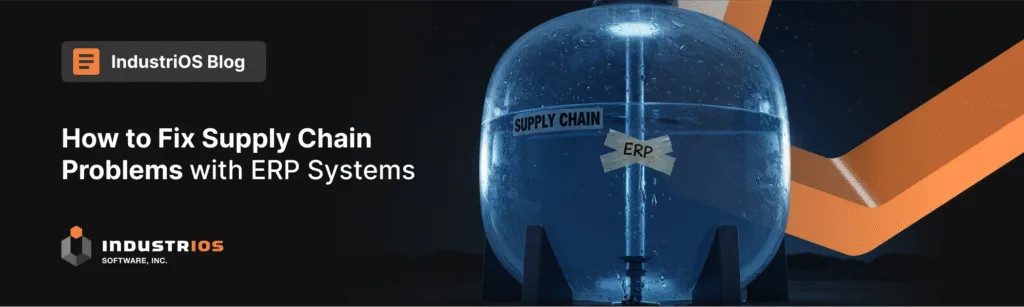
Manufacturing supply chains face multiple disruptions that can halt production and damage customer relationships. Material shortages affect 61% of manufacturers, making it the most cited supply chain challenge. Poor visibility into operations prevents manufacturers from identifying problems before they become major issues.
“Supply chain challenges affect every part of your manufacturing operation. The key is having systems that give you visibility and control when problems arise.” — Edward Szukalo, General Manager, INDUSTRIOS Software, Inc.
Production delays stem from various sources: design changes that require retooling, equipment breakdowns that halt assembly lines, and supplier delays that leave manufacturers without critical materials. These problems cascade through operations, creating bottlenecks that affect delivery schedules and customer satisfaction. Discover how ERP systems address supply chain challenges: https://poe.com/preview/iFoQKq1qy1o6srDT75kG
Problem: Raw material shortages can halt production lines within days, especially for manufacturers operating with lean inventory models.
ERP Solution: Automated reorder points and safety stock calculations prevent stockouts by triggering orders before inventory runs out. The system considers supplier lead times, demand variability, and production schedules to maintain optimal stock levels.
Multi-supplier sourcing capabilities within ERP systems help manufacturers quickly switch to alternative suppliers when primary sources face disruptions. The system maintains approved vendor lists with pricing, lead times, and quality ratings to support rapid decision-making.
Problem: Equipment breakdowns, design changes, or resource constraints create bottlenecks that slow production and delay deliveries.
ERP Solution: Real-time production monitoring identifies bottlenecks as they develop rather than after they cause delays. The system tracks work-in-progress, machine utilization, and resource availability to spot potential problems early.
Capacity planning tools help manufacturers balance workloads across machines and work centers. When bottlenecks occur, the system can suggest alternative routings or schedule adjustments to minimize disruption.
Problem: Disconnected systems and manual processes create information gaps between departments, leading to coordination problems and duplicate efforts.
ERP Solution: Centralized data eliminates information silos by giving all departments access to the same real-time information. Sales teams can see production schedules, manufacturing can view order priorities, and purchasing knows exactly what materials are needed and when.
Automated workflows ensure critical information flows between departments without manual intervention. When engineering changes occur, the system automatically updates bills of materials, notifies purchasing of new requirements, and adjusts production schedules.
Problem: Inconsistent supplier performance creates uncertainty in production planning and can lead to quality problems or delivery delays.
ERP Solution: Supplier scorecards track performance metrics like on-time delivery, quality ratings, and pricing consistency. This data helps manufacturers make informed decisions about which suppliers to use for critical materials.
Contract management capabilities ensure suppliers meet agreed-upon terms and conditions. The system can track compliance with delivery schedules, quality specifications, and pricing agreements.
INDUSTRIOS ERP provides manufacturing-specific supply chain capabilities designed to address the real challenges discrete manufacturers face daily. The system integrates inventory management, production planning, and supplier coordination into a single platform that eliminates information gaps and improves operational efficiency.
Key supply chain features include real-time inventory tracking across multiple locations, automated reorder processing with configurable safety stock levels, integrated supplier management with performance tracking, and production planning that coordinates material availability with manufacturing schedules.
“Supply chain problems require solutions that work with your existing processes, not against them. The right ERP system gives you the tools to prevent problems and respond quickly when they do occur.” — Edward Szukalo, General Manager, INDUSTRIOS Software, Inc.
The system’s PlantGauge™ dashboard transforms complex supply chain data into clear, actionable insights that help manufacturers identify problems before they become major disruptions. Integration capabilities ensure INDUSTRIOS ERP works seamlessly with existing accounting, quality management, and logistics systems.
Supply chain problems in manufacturing are complex, but ERP systems provide practical tools to address them effectively. By improving visibility, automating routine processes, and enabling better decision-making, ERP systems help manufacturers build more resilient supply chains that can adapt to changing conditions.
The key to success lies in choosing ERP solutions that fit your specific manufacturing requirements and implementing them in ways that support your existing processes while improving overall performance.
Learn More: Explore additional insights on supply chain management, manufacturing disruptions, and ERP implementation strategies through the INDUSTRIOS resource library. [Request a Demo] Ready to see how INDUSTRIOS ERP can help solve your supply chain challenges? Request a personalized demonstration to explore our supply chain management capabilities and discuss your specific manufacturing requirements with our team.

Download 1 of 11 Continuous
Improvement Templates