

Let’s explore how CAD-ERP integration can address these challenges and how INDUSTRIOS is planning to enhance its integration capabilities.
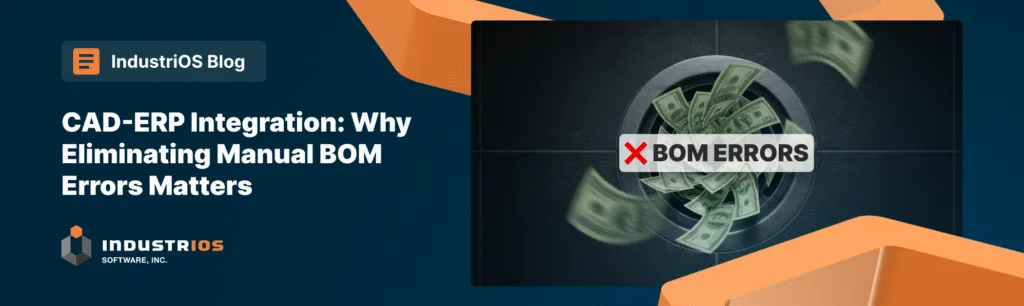
Disconnected CAD and ERP systems force engineers to manually re-enter BOM data—a process prone to errors like incorrect quantities, mismatched part numbers, or outdated revisions. These mistakes ripple through production, causing delays, material waste, and rework. For example, one manufacturer reported that a decimal point error in a BOM resulted in $45,000 worth of scrapped materials and weeks of delays.
Beyond direct costs, manual processes consume valuable engineering time. Studies show that engineers spend up to 20% of their time correcting BOM errors instead of focusing on innovation. This inefficiency impacts not only productivity but also the bottom line.
INDUSTRIOS recognizes the critical importance of CAD-ERP integration in modern manufacturing environments. The company is actively evaluating potential integration partners to provide robust solutions for its customers. While specific partnerships are still under consideration, INDUSTRIOS is committed to offering seamless integration capabilities that will bridge the gap between design and manufacturing processes.
The ideal CAD-ERP integration solution for INDUSTRIOS users would include features such as:
When INDUSTRIOS finalizes its CAD-ERP integration solution, the implementation process will be designed to minimize disruption to existing workflows. The typical process is expected to include:
Manual BOM management is unsustainable in precision-driven manufacturing environments. By automating CAD-ERP synchronization, manufacturers can reduce costly errors, improve efficiency, and focus on innovation rather than data correction.
While INDUSTRIOS is still in the process of finalizing its CAD-ERP integration strategy, the company recognizes the potential value this capability will bring to its customers. For manufacturers seeking to bridge the gap between design and production processes, CAD-ERP integration represents a critical step forward in optimizing operations and maintaining competitiveness in today’s fast-paced manufacturing landscape.

Download 1 of 11 Continuous
Improvement Templates