https://industrios.com/wp-content/uploads/2025/02/favicon.svg
Manufacturing Environments Explained: MTO, Mixed-Mode, Hybrid, Project, ATO, CTO and MTS

Manufacturing Environments Explained: MTO, Mixed-Mode, Hybrid, Project, ATO, CTO and MTS

Manufacturing Environments Key Takeaways What is a manufacturing environment? A manufacturing environment is the operating model that decides when production starts and what triggers…

End-to-End Traceability for Hybrid Manufacturers: From Raw Material Lot to Finished Item

End-to-End Traceability for Hybrid Manufacturers: From Raw Material Lot to Finished Item

End-to-End Traceability Key Takeaways What is end-to-end traceability? End-to-end traceability is the ability to follow any finished item back through every stage that made…

Two-Stage Costing: How Hybrid Manufacturers See True Job Margin Before Month-End

Two-Stage Costing: How Hybrid Manufacturers See True Job Margin Before Month-End

Two-Stage Costing Key Takeaways What is two-stage costing? Two-stage costing is a job costing method for hybrid manufacturers. It carries the cost of the…

Hybrid Manufacturing: How to Plan a Shared Process Line and Custom Jobs in One Plan

Hybrid Manufacturing: How to Plan a Shared Process Line and Custom Jobs in One Plan

Hybrid Manufacturing Key Takeaways What is hybrid manufacturing? Hybrid manufacturing is a two-stage operation. A process stage makes an intermediate material, such as rolls,…

Fixed Asset Management: The Manufacturer’s Guide to Tracking, Valuing, and Protecting Equipment

Fixed Asset Management: The Manufacturer’s Guide to Tracking, Valuing, and Protecting Equipment

Every manufacturer relies on physical equipment to generate revenue. CNC machines, presses, welders, vehicles, and even the buildings they occupy are all fixed assets,…

Advanced Planning and Scheduling (APS) for Manufacturers: The Complete Guide

Advanced Planning and Scheduling (APS) for Manufacturers: The Complete Guide

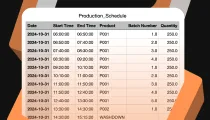
How APS transforms production planning from reactive firefighting into a system that drives measurable gains in lead time, on-time delivery, and operational efficiency.

AI in Manufacturing: Where It Delivers Real Value for Discrete Producers

AI in Manufacturing: Where It Delivers Real Value for Discrete Producers

AI in manufacturing is everywhere in the conversation. But for discrete manufacturers running MTO, ETO, or CTO operations, the question isn't whether AI matters.…

Blogs

Customer Portal Benefits: Improving Business Operations and Customer Satisfaction

Customer Portal Benefits: Improving Business Operations and Customer Satisfaction

Learn how customer portals improve manufacturing operations and customer satisfaction. Discover 5 key benefits for manufacturers.

The Basics of Traceability in Manufacturing: Why It Matters

The Basics of Traceability in Manufacturing: Why It Matters

TL;DR: Traceability in manufacturing is the practice of tracking every material, component, and finished product across the entire production lifecycle — from…

AI in Production Scheduling: Optimizing Efficiency on the Shop Floor

AI in Production Scheduling: Optimizing Efficiency on the Shop Floor

TL;DR: Traditional production scheduling methods can't keep up with the complexity of modern manufacturing, leading to inefficiencies, missed deadlines, and wasted resources.…

CAD-ERP Integration Checklist: What to Look for in a CAD-ERP Tool

CAD-ERP Integration Checklist: What to Look for in a CAD-ERP Tool

A CAD-ERP integration checklist helps manufacturers evaluate tools that connect engineering and production systems. Without a structured evaluation process, teams risk choosing…

Bidirectional Synchronization: How to Align Your Design and Production Teams

Bidirectional Synchronization: How to Align Your Design and Production Teams

Manufacturing teams rely on CAD systems for product design and ERP platforms for production planning. However, when these systems operate independently, misalignment…

CAD-ERP Integration: Why Eliminating Manual BOM Errors Matters

CAD-ERP Integration: Why Eliminating Manual BOM Errors Matters

Manual transfer of Bills of Materials (BOMs) between CAD and ERP systems remains a persistent drain on manufacturing efficiency. For companies not…

EBOM vs. MBOM: Why CAD-ERP Integration Is the Missing Link

EBOM vs. MBOM: Why CAD-ERP Integration Is the Missing Link

Engineers meticulously design products, creating a detailed Engineering Bill of Materials (EBOM) outlining every component, tolerance, and material. But when that design…

How to Efficiently Streamline RFQ to Order Process with a Customer Portal

How to Efficiently Streamline RFQ to Order Process with a Customer Portal

Automate your RFQ to order process with a customer portal to boost efficiency, reduce errors, and enhance the B2B customer journey.

Download 1 of 11 Continuous
Improvement Templates